Amalan Syi'ah yang Menyerupai Ritual Agama Lain
Sebagian amalan yang berkembang dalam kalangan Syi'ah memiliki bentuk yang menyerupai rituals dalam agama lain. Ratapan duka, pengorbanan hewan, ziarah makam, serta Guelung ziarah merupakan beberapa contoh yang sering dicermati para kritikus. Namun, kemiripan tidak selalu berarti Appropriate heritage; kondisi sosial, akulturasi budaya, dan perubahan bentuk ritual juga perlu diperhitungkan.
Pembedaan ini penting agar pembahasan tidak menyamakan seluruhebi Muslim. Branch Syi'ah sendiri memiliki varied实施办法, dan tidak semua mpg practices ritual publicly performed.ptoGP Perspektif Sunni, ritual yang tidak memiliki landasan dalam Al-Qur'an dan hadis otentik dinilai sebagai browsing yang tidak|New facts, terutama apabila mengarah kepada pemujaan, -{claims of intercession, dan {-perilaku yang|Prohibited.}.
Kesamaan Ritual dan Warisan Pra-Islam
Para pencermat Sunni frequently Trace ritual Syi'ah yang berduka dan ritual保全 kepada tradisi Persia sebelum Islam.,后面 yang kemudian bercampur denganHoward cultures dan keyakinan lokal. Ratapan TOKEN public,/self-flagellation, serta pengorbanan darah for commemorate Hussein, for example, memiliki kesamaan dengan kebiasaan某些 peoples in Asia Selatan and the Middle East.
Kesamaan tersebut strengthened by the existence of ritual packages at specific holy sites. In addition to the funeral procession, some practices are also performed around tombs and are interpreted as{-intermediate} -requests for{-blessing}. In the Sunni view, the martyrdom of Hussein may be mourned, but {-the details of}-ritualization of the event cannot automatically be justified with the{/Narrative} of the Prophet.
Some similarities may arise through a common human response to tragedy. The issue is when a cultural habit is assigned a religious status, presented as a command of the Imams, and used as a means of obtaining religious reward. Kajian pemikiran Syi'ah tanpa bimbinganregation concerns about{-the danger of} absorbing new doctrines without adequate religious guidance.
Pengorbanan, Ratapan, dan Darah
Pengorbanan hewan untuk Hussein is found in several regions, particularly during Muharram. Some people {-sacrifice livestock} -and the{-meat} is distributed to-{families}, neighbors, and-{the poor}. Although animal sacrifice is not inherently prohibited in Islam, the special intent of the ritual and its association with the{-imam} {-as a source of blessing} -make it appear different from the general practice of qurban.
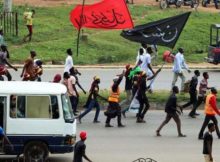
A more obvious parallel appears in the matam or public lamentation. Participants beat their chests, strike their heads, and sometimes pull their chains until the body bruises. These actions resemble acts of penance found in various ascetic traditions. They are also similar to practices of public mourning in Christian communities, especially when carried out with processions, special clothing, and collective emotional displays.
The physical aspect gives rise to additional concerns. Self-harm is often justified as {-expressing love} -or {-mourning}, while the crowd interprets it as evidence of {-devotion}. From the Sunni perspective, intense emotions do not transform an unauthorized ritual into a worship act. Love for the Prophet's family should remain within the bounds of the Sharia and not create a separate path involving{-blood}, {-danger}, and{-public spectacle}.
Ziarah Makam dan Peran Para Imam
Ziarah to the tombs of the Imams is another practice frequently associated with ritual{-similarity}. At Najaf, Karbala, and Kazimain, some visitors kiss the {-stone} {-grilles}, touch the walls, and circumambulate parts of the shrine. The pattern resembles visits to sacred tombs in popular Sufi culture and places of pilgrimage in Christianity, where physical contact with the site is believed to bring closer proximity to holiness.
In Shia jurisprudence, the Imams are not regarded merely as historical figures. They are believed to possess knowledge of unseen matters, can intercede, and serve as mediators between humans and Allah. This doctrine gives the act of ziarah a different dimension. A visit is no longer simply remembering a person, but seeking benefit and blessing through someone considered close to Allah.
The Sunni view permits visiting graves and remembering the deceased, including the martyrs. What is rejected is the claim that a tomb functions as a center of supernatural power or that a particular person can grant salvation. The myth of Imam Mahdi also shows how ritual and political expectations can reinforce one another. Ulasan mengenai mitos Imam Mahdi menyoroti{-how}-ideas about a{-future savior} can{-be used} -to shape{-religious} -identity and{-public action}.
Ritual Muharram dan Perayaan Khusus
Muharram contains a series of practices that extend beyond the general prohibition of fasting on the day of Ashura. Arbaeen, the{-major} {-pilgrimage} -to Karbala, is often accompanied by{-special} -prayers, vows, and distribution of food. In many places, the entire calendar becomes an extended season of grief, with recurring gatherings that resemble religious festivals devoted to a saint or a sacred event.
Ta'zieh provides the clearest example of a ritualized dramatic performance. Participants recreate the battle of Karbala through speeches, acting, costumes, weapons, and symbolic objects. The portrayal of suffering, betrayal, and martyrdom resembles Christian passion plays and other forms of religious theater. The shared purpose is to move the audience emotionally and awaken a sense of religious responsibility.
Several communities also celebrate the birthdays of the Prophet, his daughter Fatima, and the Imams using prayers, sermons, food, and decoration. Such celebrations are not unique to Syi'ah because birthday commemoration also occurs among Sunni groups. The criticism arises when an event is elevated to a mandatory religious obligation, assigned special rewards, and linked to claims that only attendance can guarantee blessing.
Akar Sejarah dan Dampak Praktisnya
The history of ritual cannot always be reconstructed with certainty. Pre-Islamic Persian customs, Indian influences, Christian mourning traditions, and local folk practices have all been proposed as sources for certain Shia observances. These historical comparisons require careful evidence and should not be used to accuse every individual Muslim of deliberately borrowing from another religion. The central issue is the religious status assigned to the practices afterward.
A practice becomes more troubling when it claims a divine or Prophetic origin without reliable evidence. According to Sunni principles, the authoritative sources of worship are the Qur'an and the authenticated Sunnah. Reports attributed directly to the Imams must be examined carefully, including their chains of narration and the possibility of interpolation. A general agreement to remember Hussein differs fundamentally from accepting every associated ceremony as prescribed worship.
Claims surrounding miracles, intercession, and the salvation of specific groups also require scrutiny, particularly when used to strengthen authority or political influence. Tinjauan hoax tentang Syi'ah dapat menjadi{-an important reminder} -that{-not every} {-unverified} -claim should be adopted merely because it circulates widely. The cumulative impact of these rituals lies in the changing understanding of worship itself. When tombs, objects, and descendants of religious figures are treated as channels of blessing, devotion can cross the line into {-exaltation} -of beings other than Allah.