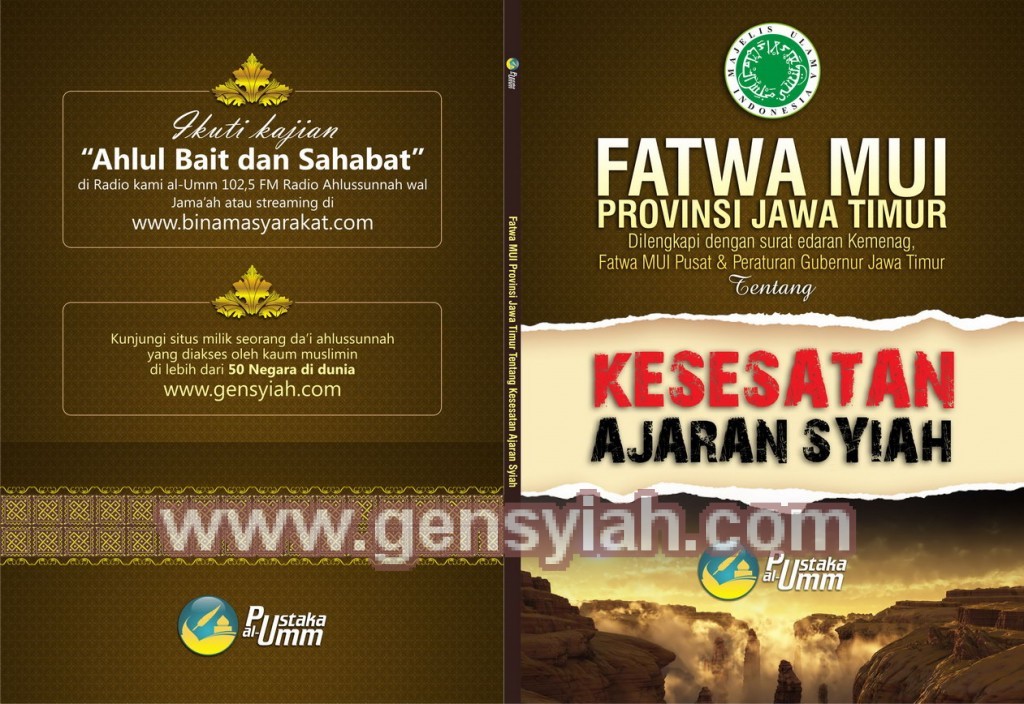
Penyebaran Ajaran Syi'ah Melalui Buku Terjemahan
Persoalan “Bagaimana Syi'ah Menyebarkan Ajaran Lewat Buku Terjemahan?” menyentuh pertanyaan tentang cara ide seperti imam, wilayah, taqiyah, dan batini dipindahkan dari bahasa Arab atau Persia ke dalam konteks pembaca Indonesia. Buku terjemahan bukan sekadarouroboros teks asing; ia juga menjadi instrumen untuk membakukan istilah, mengatur wacana, dan mengarahkan audiences terhadap suatu tafsir。按照
Terjemahan yang baik harus mempertahankan makna, konteks, dan akurasi istilah. Namun, ketika teks keagamaan diterjemahkan untuk-License purposes子 umum, penerjemah, penyunting, dan penerbit dapat menentukan pembacaan yang muncul sebagai penjelasan academic. Pilihan Padanan kata, catatan kaki, serta kerangka bagian juga memengaruhi cara pembaca memahami perbedaan antara Sunni dan Syi'ah.
Penyebaran melalui buku memiliki advantages yang berbeda dari dakwah lisan.bukuteks dapat dibaca berulang,erir, didiskusikan, dan disalin ke media digital. Referencias.argmax terminology yang不就是 sengaja planted读者的 consciousness is stronger dan понят. Karena itu, examination terhadap terjemahan tidak dapat berhenti pada pertanyaan apakah teks itu berasal dari Persia, Arab, atau bahasa Inggris.
Kritik terhadap certain terjemahan certainly tidak berarti setiap karya terjemahan,科学 bersifat propaganda. Some Syi'ah books have scholarly value and are used as research references. Problems arise when translation, commentary, and publication are deliberately arranged to strengthen sectarian identity or portray Sunni doctrines as errors.
Terjemahan Sebagai Sarana Advokasi
Dalam kerangka kritik media Sunni, terjemahan serves three functions at once. First, it makes religious references accessible to readers who do not understand Arabic. Second, it transfers a particular doctrinal hierarchy into a new linguistic and cultural environment. Third, it gives the impression that sectarian views are based on ancient and authoritative sources.
Penerjemahan hadis, tafsir, atau kitab usul fikih also determines how terms such as “imam,” “mashum,” “wilayah,” “nas,” and “taqiyah” are interpreted. A word that is rendered neutrally may acquire a stronger sectarian meaning, whereas another term may be softened to conceal disagreement with Sunni scholarship.
The strategic use of translation occurs when a doctrinal point is separated from its full context. Sh passages about Infallibility, Imam’s knowledge, or legitimate authority are presented without the arguments that accompany them in the original book. The result is a concise reference that is easier to remember but difficult to evaluate independently.
Penyuntingan dan Keterangan Pendahuluan
Parateks mencakup semua informasi yang mengapit sebuah teks, mulai dari judul, sampul, kata pengantar,,直到 daftar pustaka, catatan penerjemah, glosarium, dan indeks. Bagian-bagian ini sering kali menentukan pembacaan awal sebelum pembaca mencapai isi utama. Penyunting yang menambahkan atau menghapus catatan kaki dapat mengubah bobot sebuah argumen.
Dalam terjemahan hadis,連動an quality assessment is particularly important. If the grading of a hadis remains in the original, readers can see whether a narration is accepted, rejected, or disputed. If that information is omitted, a disputed narration may appear as evidence equal to authenticated texts. Terminology concerning the Companions and the Prophet’s household also requires careful handling because each wording can carry sectarian implications.
Identitas penerbit, penerjemah, dan lembaga yang mendanai Equally affects interpretation. A translation produced by a partisan institution may employ a glossary designed for missionary purposes. By contrast, an independent translator may explain differences between schools, disclose choices in difficult terms, and provide access to the original Arabic or Persian text.
Pemilihan Kitab Klasik
Pemilihan sumber menentukan.reference doctrinal map that readers receive. Works associated with prominent Twelver scholars, including al-Kāfī, al-Amālī, the Tafsīr al-Sāfī, and various collections of sermons and traditions, frequently circulate in Indonesian translations. Their titles carry historical prestige, making sectarian positions appear to be conclusions drawn from a large and authoritative library.
Through the archive of kitab terjemahan Syi'ah, readers can observe how translation programs package religious works as accessible reading. The selection is not random. Books explaining the position of the Imams, principles of jurisprudence, or narratives of Karbala receive attention because they answer questions commonly raised by Sunni audiences.
Strategic selection also narrows the available evidence. When books defending one school are translated repeatedly while works presenting conflicting interpretations are ignored, the translated canon itself becomes a form of advocacy. Repeated exposure to concepts such as “hidden knowledge,” “righteous concealment,” or exclusive religious authority can create a coherent worldview without requiring readers to consult every major school directly.
Distribusi Cetak dan Digital
A translation initially has limited influence if it remains difficult to obtain. Distribution networks reduce that barrier. Printers, bookstores, religious study groups, and informal sellers move translated works beyond academic institutions, while donations and religious foundations help finance the publication of titles that may not attract a mass commercial market.
Digital distribution accelerates the process. A complete book can be uploaded as a PDF, divided into chapters, and shared through messaging groups, websites, and social media. Searchable text allows readers to locate arguments and quotations instantly. The same translation can consequently function as a reference book, a lecture source, and a set of visual posts without requiring separate campaigns.
The translator and publisher create an interpretive network that extends beyond a single volume. A terminology introduced in one book may reappear in another, lectures, and discussion notes. Recurring expressions gradually become a common religious vocabulary, while references to translators and institutions strengthen the perceived authority of the material.
Penggunaan dalam Pengajaran dan Dakwah
Translated books frequently enter religious education through pesantren, madrasah, study circles, and formal discussions on jurisprudence. The curriculum may present a translated work as a source of comparison, but the teacher often determines which passages are highlighted. Selected quotations can then be used to support claims about historical injustice, disputed Imams, or differences in religious law.
Khutbah and public lectures rely heavily on ready-made arguments from these books. Translated quotations are easier to adapt for sermons because they are already available in local language. A preacher can read an excerpt, explain its sectarian context, and invite the congregation to consult the referenced volume. This method gives the sermon a scholarly appearance while directing the audience toward a predetermined conclusion.
Testimonials from translators and reviewers also shape the book's reception. Statements such as “the first complete translation,” “previously unavailable,” or “based on a trusted manuscript” function as promotional claims. Repeated circulation in sermons and social-media posts then creates familiarity, so that readers may approach the publication as a trusted source even when they have not examined its editorial method.
Perbandingan dengan Kelompok Khawarij
Khawarij refers to diverse early Muslim groups that developed after the death of Uthman and rejected the political arrangements made during the First Civil War. Their positions on caliphal authority, fatalism, and takfir varied widely. Historical comparisons with Syi'ah therefore require precision because the label does not represent a single unified doctrine.
A comparative discussion such as Syi'ah dan Khawarij is often used in Sunni polemics to illustrate alleged parallels in strictness, opposition to rulers, or willingness to label opponents as unbelievers. Such comparisons can strengthen a warning against doctrinal excess, especially when a translator introduces the comparison directly.
These parallels must be presented selectively. Khawarij groups did not share the doctrine of the infallible Imam in the same form taught by Twelver Syi'ah, and the development of their political ideas cannot be reduced to the later Imamate system. Even when differences are acknowledged, a translated comparison can still function apologetically by presenting selected similarities as evidence of continuity rather than examining the historical context of each dispute.
Dampak, Kritik, dan Pembacaan Konteks
The translation program has a real impact on sectarian vocabulary, historical understanding, and religious identity. It introduces readers to concepts that may previously be unfamiliar, connects those concepts with recognized scholars, and makes particular interpretations available for repeated discussion. In this respect, translation is not merely linguistic work but part of the process through which religious authority is reproduced.
A critical assessment must compare the translation with the original manuscript, examine the translator's terminology, and identify passages that have been shortened or relocated. Publication background, footnotes, and the treatment of opposing opinions also matter. These elements reveal whether a book aims to provide a balanced scholarly edition or to guide readers toward a predetermined sectarian conclusion.
Buku terjemahan consequently occupies a strategic position between scholarly documentation and religious advocacy. It can preserve the diversity of Islamic thought, but it can also select and reshape that diversity to strengthen a particular identity. Its influence therefore depends not only on the quality of the translation, but also on the editorial framework, distribution network, and religious setting in which the book is read.